Introduction
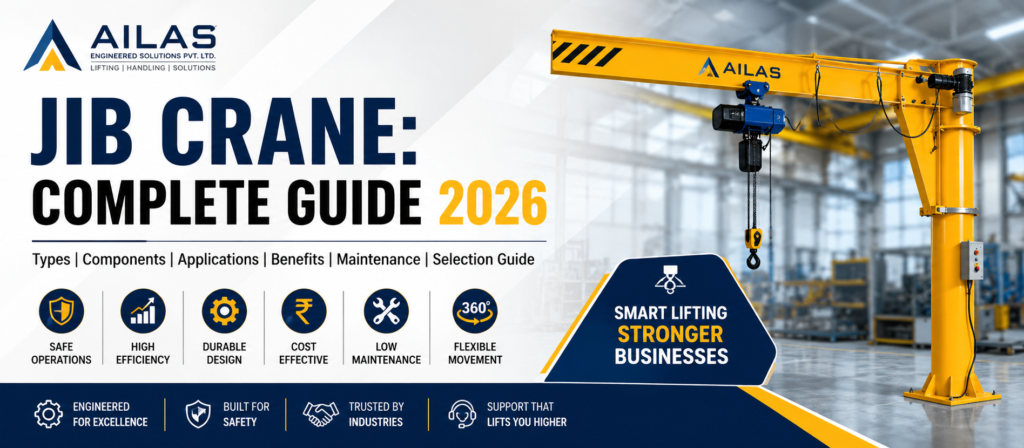
In modern industrial environments, efficient material handling is essential for improving productivity, workplace safety, and operational efficiency. Among the most versatile lifting solutions available today, the JIB Crane stands out as a cost-effective and flexible system for lifting, moving, and positioning loads within a specific work area.
At Ailas Engineered Solutions Pvt. Ltd., we design and manufacture high-quality JIB cranes engineered to meet the demands of various industries, including manufacturing, warehousing, automotive, construction, and logistics.
This comprehensive guide explains everything you need to know about JIB cranes in 2026, including their types, components, applications, benefits, and selection criteria.
Table of Contents
- What is a JIB Crane?
- How Does a JIB Crane Work?
- Main Components of a JIB Crane
- Types of JIB Cranes
- Applications of JIB Cranes
- Advantages of Using JIB Cranes
- JIB Crane Capacity and Specifications
- How to Choose the Right JIB Crane
- Maintenance Tips for JIB Cranes
- Why Choose Ailas Engineered Solutions Pvt. Ltd.?
- Frequently Asked Questions
- Conclusion
What is a JIB Crane?
A JIB Crane is a lifting device consisting of a horizontal boom (jib arm) attached to a vertical support structure. It allows loads to be lifted and moved within a circular or semi-circular working area.
Unlike overhead cranes that cover an entire facility, JIB cranes are ideal for localized lifting tasks and workstation operations.
How Does a JIB Crane Work?
The crane operates using:
- A horizontal arm (jib)
- A hoist for lifting loads
- A trolley that moves along the jib arm
- A supporting pillar or wall-mounted structure
The hoist lifts the load while the trolley moves it along the jib arm. The arm itself can rotate, providing flexible load positioning.
Main Components of a JIB Crane
- Jib Arm
The horizontal beam supporting the hoist and trolley.
- Hoist
Responsible for lifting and lowering loads.
- Trolley
Moves the load horizontally along the jib arm.
- Mast or Pillar
Provides structural support to the crane.
- Rotation Mechanism
Allows the crane arm to rotate for better coverage.
- Foundation/Base Plate
Ensures stability and secure installation.
Types of JIB Cranes
- Pillar Mounted JIB Crane
Mounted on an independent floor-mounted pillar.
Features:
- 360° rotation
- High load capacity
- Independent operation
Applications:
- Manufacturing plants
- Warehouses
- Assembly stations
- Wall Mounted JIB Crane
Installed directly on building walls or columns.
Features:
- Space-saving design
- No floor obstruction
- Cost-effective
Applications:
- Workshops
- Production facilities
- Storage areas
- Wall Traveling JIB Crane
Moves along a wall-mounted track system.
Features:
- Extended coverage
- Flexible operation
- Increased productivity
- Articulating JIB Crane
Features multiple pivot points for complex load positioning.
Features:
- Maximum flexibility
- Ideal for confined spaces
- Precise load handling
Applications of JIB Cranes
JIB cranes are widely used in:
Manufacturing Industries
- Machine loading and unloading
- Assembly operations
Automotive Sector
- Engine handling
- Component movement
Warehousing
- Material transfer
- Inventory handling
Construction Industry
- Equipment lifting
- Material positioning
Logistics Centers
- Loading and unloading operations
Fabrication Workshops
- Metal fabrication handling
- Welding stations
Advantages of Using JIB Cranes
Increased Productivity
Reduces manual handling and speeds up workflow.
Improved Workplace Safety
Minimizes employee strain and lifting injuries.
Cost-Effective Solution
Lower installation and maintenance costs compared to larger crane systems.
Flexible Operation
Provides excellent load positioning capabilities.
Space Optimization
Ideal for areas with limited space.
Easy Installation
Can be installed quickly with minimal facility modifications.
JIB Crane Capacity and Specifications
Modern JIB cranes are available in:
| Parameter | Typical Range |
| Load Capacity | 125 kg – 10 Tons |
| Span Length | 2m – 12m |
| Rotation | 180° – 360° |
| Lift Height | Customized |
| Hoist Type | Electric or Manual |
Custom specifications can be designed based on application requirements.
How to Choose the Right JIB Crane
Consider the following factors:
Load Capacity
Determine maximum lifting requirements.
Span Length
Evaluate working area dimensions.
Rotation Requirement
Choose between 180°, 270°, or 360° rotation.
Installation Space
Assess floor and wall availability.
Frequency of Operation
Consider duty cycle and operational intensity.
Future Expansion
Select a crane that accommodates future growth.
Maintenance Tips for JIB Cranes
Regular maintenance helps ensure safe and efficient operation.
Daily Inspection
- Check hooks and wire ropes
- Inspect controls
Weekly Maintenance
- Lubricate moving parts
- Check trolley movement
Monthly Inspection
- Examine structural components
- Verify electrical systems
Annual Testing
- Conduct load testing
- Perform safety audits
Why Choose Ailas Engineered Solutions Pvt. Ltd.?
Ailas Engineered Solutions Pvt. Ltd. is a trusted manufacturer of industrial lifting solutions offering:
- Custom-engineered JIB cranes
- Superior build quality
- Advanced safety features
- Competitive pricing
- Reliable after-sales support
- Nationwide installation services
Our solutions are designed to improve operational efficiency while maintaining the highest safety standards.
Frequently Asked Questions (FAQs)
What is the maximum capacity of a JIB crane?
JIB cranes are available in capacities ranging from 125 kg to 10 tons, depending on the application.
Where are JIB cranes commonly used?
They are widely used in manufacturing plants, warehouses, workshops, logistics centers, and assembly lines.
What is the difference between a JIB crane and an overhead crane?
JIB cranes serve localized workstations, while overhead cranes cover larger facility areas.
Can a JIB crane rotate 360 degrees?
Yes, pillar-mounted JIB cranes typically offer full 360° rotation.
How long does a JIB crane last?
With proper maintenance, a high-quality JIB crane can operate efficiently for 15–25 years or more.
Are JIB cranes customizable?
Yes. Load capacity, span length, lift height, rotation angle, and hoist options can be customized.
What industries benefit most from JIB cranes?
Manufacturing, automotive, logistics, construction, engineering, and warehousing industries benefit significantly.
Conclusion
JIB cranes continue to be one of the most efficient and economical material handling solutions in 2026. Their flexibility, reliability, safety, and ease of operation make them essential for industries seeking improved productivity and reduced manual labor.
If you are looking for high-performance JIB cranes tailored to your operational needs, Ailas Engineered Solutions Pvt. Ltd. offers advanced lifting solutions designed for long-term reliability and efficiency.